When a couple is having difficulty conceiving, much of the attention often falls on the female partner. But fertility is a shared equation, and male reproductive health is an important part of the picture.
Male fertility can be affected by sperm concentration, movement, shape and function, as well as hormonal, structural, genetic, environmental and lifestyle factors. Understanding these factors can help couples make more informed decisions about their fertility care.
At the Acupuncture Clinic of Boulder, we have worked with fertility patients for many years, using acupuncture and Traditional Chinese Medicine as complementary care alongside reproductive endocrinology, OB/GYN care, reproductive urology, IUI, IVF and other fertility treatments.
Whether you are just beginning to investigate your fertility or are already working with a fertility specialist, our goal is to support your overall health while you move through the process.

Male Infertility Is More Common Than Many People Realize
Infertility affects approximately 1 in 6 people of reproductive age worldwide during their lifetime, according to the World Health Organization.
In the male reproductive system, infertility may be related to low or absent sperm, problems with semen delivery, or abnormalities in sperm movement or shape.
This is one reason fertility evaluation should not focus exclusively on the female partner. When pregnancy is not occurring as expected, evaluating both partners can provide a much clearer picture.

Understanding a Semen Analysis
A semen analysis is one of the primary tools used to evaluate male fertility. Although a fertility specialist may consider many different measurements, three terms come up frequently:
Sperm Concentration
Sperm concentration describes how many sperm are present in a given volume of semen.
Sperm Motility
Motility describes how sperm move. Progressive motility refers to sperm that are moving forward rather than remaining stationary or moving without effective forward progression.
Sperm Morphology
Morphology refers to sperm shape and structure.
It is important to remember that semen-analysis results are not simply a pass-or-fail fertility test. Results need to be interpreted within the larger clinical picture, and semen parameters can vary from one sample to another.
If an analysis is abnormal, a physician may recommend repeating the test or referring the patient to a reproductive urologist or other male fertility specialist.
What Can Affect Male Fertility?
Healthy sperm production depends upon a complex interaction among the brain, hormones, testes and reproductive tract. Many different conditions can interfere with this process.
Potential factors may include:
- Varicocele
- Hormonal abnormalities
- Genetic conditions
- Previous infections or illness
- Undescended testes
- Obstruction of the reproductive tract
- Certain medications or medical treatments
- Radiation or chemotherapy
- Environmental or occupational exposures
- Tobacco use
- Excessive alcohol consumption
- Some recreational drugs
- Overall metabolic and general health
Sometimes a specific cause can be identified and treated. In other cases, abnormal semen parameters occur without an obvious explanation.
This is why acupuncture should complement rather than replace a medical fertility evaluation. Finding a treatable underlying cause is an important part of male fertility care.
Sperm Production Takes Time
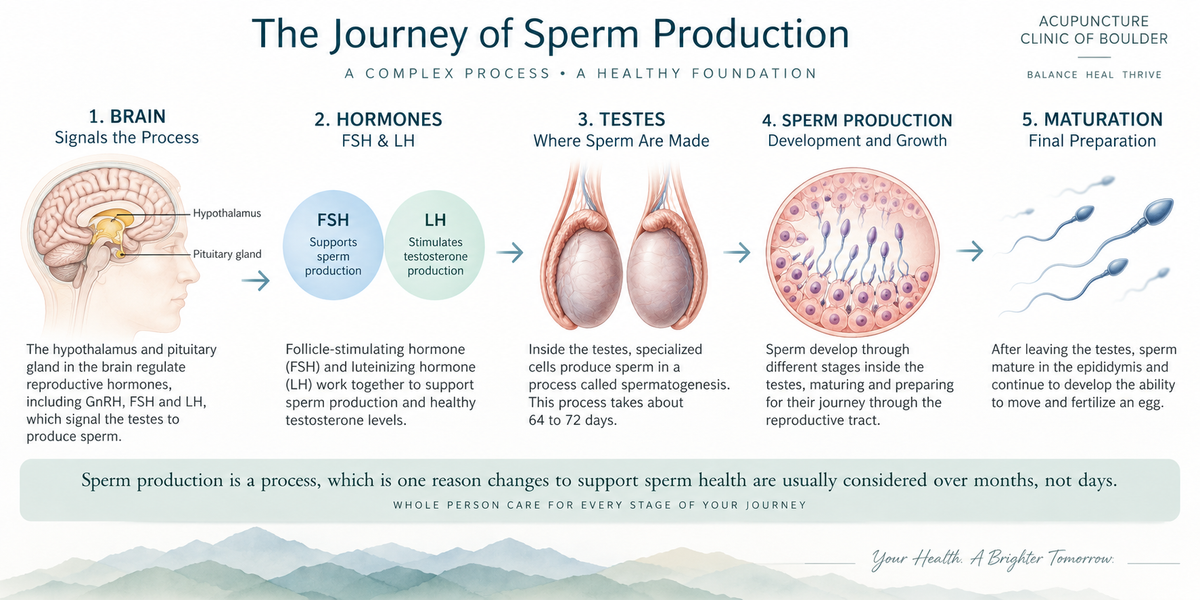
Sperm do not develop overnight.
Sperm production begins in the testes through a carefully regulated hormonal process involving the hypothalamus and pituitary gland in the brain and hormones including FSH, LH and testosterone.
Once sperm are produced, they continue through a process of maturation before ejaculation.
This is one reason changes intended to support sperm health are generally considered over a period of months rather than days or weeks.
It is also one reason a single semen analysis may not tell the entire story.
Can Acupuncture Support Male Fertility?
Acupuncture has been studied as a complementary therapy for male fertility, including its potential effects on sperm concentration and motility.
Some research has reported improvements in certain semen parameters following acupuncture. However, the overall body of research remains limited, and studies have varied considerably in quality and methodology.
For that reason, we do not view acupuncture as a substitute for medical evaluation or fertility treatment.
Instead, we use acupuncture as part of an integrative approach to male reproductive health, working alongside the medical care a patient may already be receiving.
At the Acupuncture Clinic of Boulder, treatment is individualized. Two men can arrive with similar semen-analysis results yet have very different health histories, symptoms and Chinese medicine patterns.

Male Fertility Through the Lens of Traditional Chinese Medicine
Traditional Chinese Medicine looks at fertility somewhat differently from conventional medicine.
Rather than treating a semen-analysis number alone, Chinese medicine considers the patient’s broader pattern of health.
Historically, male reproductive concerns have been associated with patterns involving the Kidneys, Liver, Qi, Blood, Yin, Yang, Dampness and Heat.
For example, one patient may experience fatigue, low-back weakness and feeling unusually cold, while another may present with signs of heat, inflammation, stress or stagnation.
These distinctions matter in Chinese medicine because acupuncture point selection and herbal treatment are individualized according to the patient’s presentation.
Kidney Yang Deficiency
Traditional signs may include:
- Feeling cold
- Low-back weakness or discomfort
- Fatigue
- Coldness in the lower abdomen or genital region
- Frequent urination
- A deep or weak pulse
Kidney Yin Deficiency
A different presentation may include:
- Feeling warm or experiencing night heat
- Irritability
- Dryness
- Restlessness
- A redder tongue
- A thinner or weaker pulse
Damp Heat
Other patients may exhibit signs traditionally interpreted as Damp Heat, particularly when inflammation, heaviness or genitourinary symptoms are present.
Blood Stasis and Varicocele
In Chinese medicine, the impaired circulation associated with a varicocele may be interpreted through the concept of Blood Stasis.
From a conventional medical perspective, however, a varicocele is a medical condition involving enlarged veins within the scrotum. Men with a suspected or diagnosed varicocele should be appropriately evaluated by a physician or reproductive urologist.
Acupuncture and Chinese medicine can then be considered as complementary care where appropriate.
Chinese Herbal Medicine and Male Fertility
Chinese herbal medicine has a long history of use in reproductive medicine.
Traditional formulas are selected according to an individual’s Chinese medicine diagnosis rather than simply prescribing the same “fertility formula” to every patient.
For example, classical Chinese medicine includes different approaches for patterns traditionally described as Kidney Yang deficiency, Kidney Yin deficiency, Damp Heat and Blood Stasis.
Because herbs can interact with medications and may not be appropriate during every phase of fertility treatment, we recommend individualized prescribing and coordination with your fertility team when appropriate.
Never begin a Chinese herbal formula solely because it is described online.
What About Supplements for Male Fertility?
Antioxidants, vitamins and nutritional supplements are widely marketed to men who are trying to improve sperm quality.
More supplementation, however, is not necessarily better.
Research has investigated nutrients and compounds such as zinc, selenium, vitamins C and E, carnitine and other antioxidants, but evidence supporting specific supplements for treating male infertility remains uncertain.
The American Urological Association and American Society for Reproductive Medicine advise clinicians that the benefits of supplements such as antioxidants and vitamins for male infertility are of questionable clinical utility and that available evidence is inadequate to recommend specific agents.
Rather than automatically taking high-dose supplements, talk with your physician or another qualified healthcare professional about your individual needs, particularly if you take medications or are undergoing fertility treatment.
Supporting Sperm Health
There is no single diet, supplement or lifestyle change that guarantees improved fertility. However, supporting overall health remains worthwhile for people who are trying to conceive.
Depending on your individual situation, your healthcare team may discuss:
- Eating a balanced, nutrient-rich diet
- Regular physical activity
- Avoiding tobacco
- Moderating or avoiding alcohol
- Discussing recreational drug use with your healthcare provider
- Managing underlying health conditions
- Reviewing medications and supplements with your physician
- Addressing significant occupational or environmental exposures
- Getting adequate sleep
- Managing stress and supporting emotional well-being
Do not discontinue a prescription medication because of fertility concerns without first discussing it with the prescribing clinician.
Fertility Is a Whole-Couple Conversation
Fertility challenges can be physically and emotionally difficult for both partners.
Male partners can sometimes feel as though they are standing on the sidelines while the female partner undergoes testing, procedures, medications and fertility treatments. But male reproductive health deserves attention too.
At the Acupuncture Clinic of Boulder, we can work with one partner or both.
For couples going through IUI or IVF, this may mean supporting both people during the months leading up to a treatment cycle. For couples trying to conceive naturally, it may mean creating an individualized plan based upon each person’s health and fertility evaluation.
Our goal is not to replace your fertility specialists. It is to be another supportive part of your care team.
Male Fertility Acupuncture in Boulder, Colorado
The Acupuncture Clinic of Boulder provides acupuncture and Traditional Chinese Medicine for individuals and couples navigating fertility concerns.
We work with patients at many different stages of the fertility journey, including:
- Trying to conceive naturally
- Preparing for fertility treatment
- IUI
- IVF
- Male-factor fertility concerns
- Stress and emotional support during fertility treatment
- General reproductive and whole-body wellness
We believe fertility care works best when patients feel informed, supported and actively involved in their healthcare.
If you have semen-analysis results or recommendations from your fertility specialist, you are welcome to bring them to your appointment so we can better understand the care you are already receiving.
Looking for Male Fertility Acupuncture in Boulder?
We’d be happy to talk with you about how acupuncture and Chinese medicine may fit alongside your current fertility care.
Schedule Here
Acupuncture Clinic of Boulder | Boulder, Colorado
Frequently Asked Questions About Acupuncture and Male Fertility
Can acupuncture improve sperm quality?
Acupuncture has been studied for its possible effects on semen parameters including sperm concentration and motility. Some studies have reported improvements, but the research remains limited and inconsistent.
We therefore use acupuncture as complementary care rather than presenting it as a proven treatment for male infertility.
Can acupuncture help sperm motility?
Some clinical research has reported changes in sperm motility following acupuncture. However, more high-quality research is needed to determine how meaningful these changes are for fertility and pregnancy outcomes.
Can acupuncture improve sperm morphology?
Sperm morphology has also been studied in relation to acupuncture, but there is not enough high-quality evidence to guarantee that acupuncture will improve morphology.
If morphology is abnormal, we recommend discussing the finding with your fertility specialist or reproductive urologist while considering acupuncture as complementary support.
How long should I do acupuncture for male fertility?
There is no universal treatment schedule that is appropriate for every patient.
Because sperm production and maturation occur over a period of months, male fertility care is often approached over a longer period rather than expecting changes after one or two treatments.
Your acupuncture treatment plan should be based on your health history, fertility evaluation, treatment goals and whether you are trying naturally or preparing for IUI or IVF.
Should I have a semen analysis before starting acupuncture?
You don’t necessarily need a semen analysis before receiving acupuncture. However, if you have been trying to conceive without success, appropriate fertility testing can provide valuable information and help identify conditions that may require medical treatment.
Can both partners receive fertility acupuncture?
Yes. We frequently work with fertility from a whole-couple perspective.
Each partner receives an individualized treatment plan based upon their own health history and needs rather than identical treatments.
Can I receive acupuncture while we are doing IUI or IVF?
Acupuncture is often used as complementary care by patients undergoing fertility treatment. Tell your acupuncturist about your medications, procedures and fertility-treatment schedule so your care can be coordinated appropriately.
Originally published June 12, 2014 | Updated September 2026
References & Further Reading
Randine Lewis, L.Ac., “Male Factor Infertility”
World Health Organization. Infertility. Updated November 2025.
World Health Organization. Guideline for the Prevention, Diagnosis and Treatment of Infertility. 2025.
American Urological Association/American Society for Reproductive Medicine. Diagnosis and Treatment of Infertility in Men: AUA/ASRM Guideline. Amended 2024.
Jerng UM, Jo JY, Lee S, Lee JM, Kwon O. The effectiveness and safety of acupuncture for poor semen quality in infertile males: a systematic review and meta-analysis. Asian Journal of Andrology. 2014.
This article is intended for educational purposes and is not a substitute for individualized medical diagnosis or treatment.